
May 19, 2026 ● Roger Lear
AI, Art and History Majors, and the Jobs That Still Need Humans
When UCF graduates booed during a commencement speech about artificial intelligence, I understood the reaction.
It reminded me of when the internet first came online. For some of my younger readers, yes, I was there for that too. I had just graduated, started a recruiting firm, and plenty of people told me the “World Wide Web” was going to replace recruiters.
I didn’t believe that. But I also didn’t ignore it.
Instead, I leaned into it. I started GreatInsuranceJobs.com 25 years ago and OrlandoJobs.com 20 years ago because I believed technology was not going to replace the human side of hiring. It was going to change how we connect people to opportunity.
And guess what?
I am still recruiting. Still running job boards. Still talking to employers. Still helping job seekers. Still being human.
Looking back, I am very glad I embraced the technology instead of listening to people who, as it turned out, did not really understand where the internet was going.
That is why I think the reaction from the UCF graduates matters. The fear is real. I get it. If you are an art major, history major, writer, designer, or creative student, AI can feel like it is coming straight for your future.
But here is the part we have to talk about honestly: new technology always changes jobs. It may eliminate some tasks. It may make some old job descriptions disappear. But it also creates new work, new industries, and new ways for talented people to stand out.
The question is not, “Will AI change creative careers?”
It already is.
The real question is: will creative people help shape what comes next?
And let’s be real. Some jobs will change. Some basic creative tasks already are changing. Routine freelance writing, basic image creation, translation, stock photography, and low-level production design are under pressure. Oxford researchers found that some freelance writing and translation jobs have seen demand drop by 20% to 50% in areas where AI can partly substitute the work.
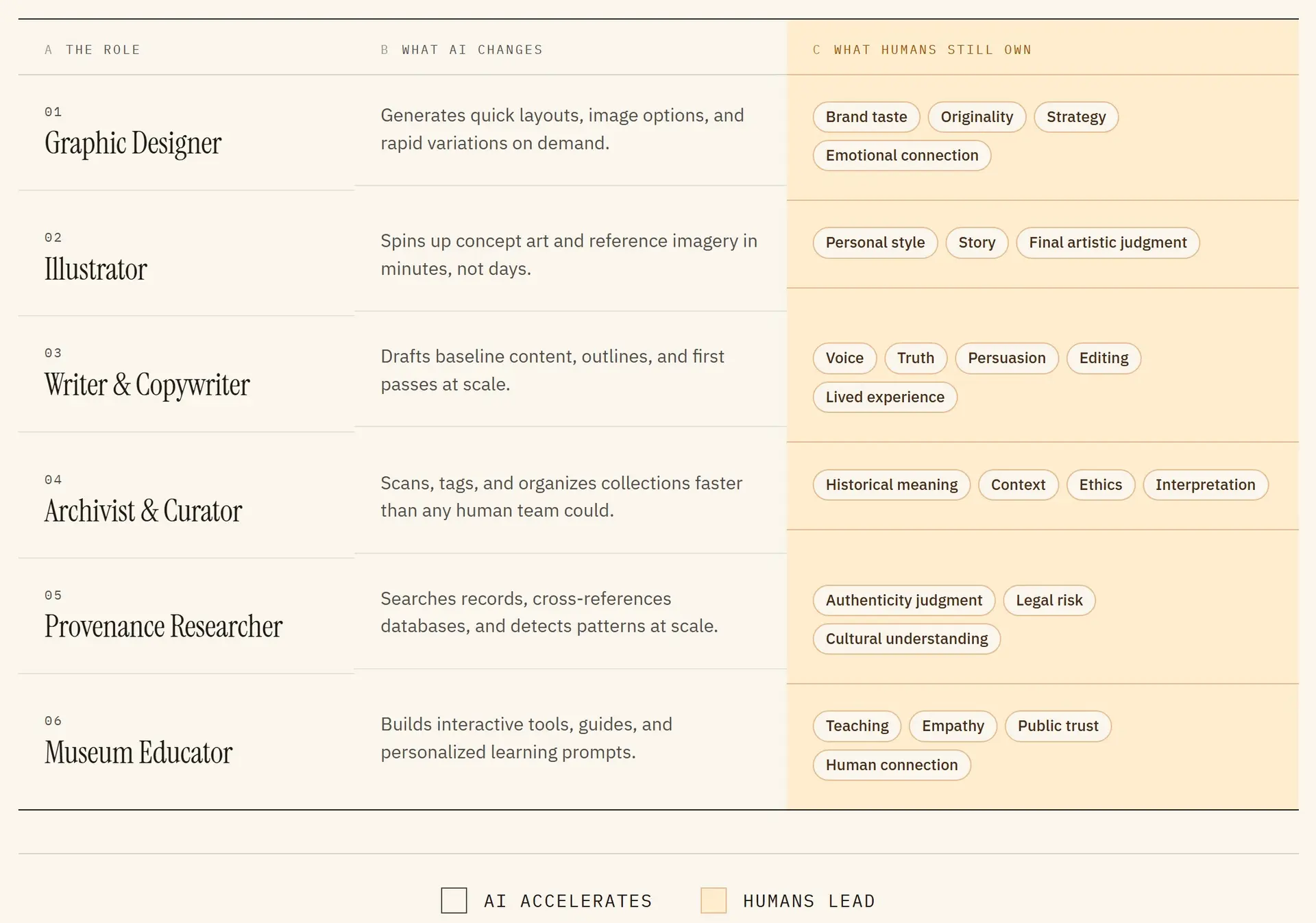
Graphic design is a perfect example. Is graphic design “over”? No. But the old version of graphic design, where someone is hired mainly to make quick layouts, simple graphics, or basic social media images, is absolutely being challenged. The Bureau of Labor Statistics still projects graphic designer employment to grow 2% from 2024 to 2034, but that is slower than average.
So what replaces it?
The better designer of the future will not just “make graphics.” They will direct brand identity, build campaigns, use AI tools to create faster concepts, edit what AI gets wrong, protect originality, understand audiences, and make sure the final work actually connects with humans.
That is the shift.
The job is moving from creator of every pixel to creative director of meaning.
History majors are in the same boat. AI can scan documents, summarize archives, and find patterns across huge collections. But it cannot fully understand context, ownership, culture, ethics, or why an object matters. That is why jobs like curator, archivist, museum technician, cultural heritage researcher, and provenance specialist are not disappearing. In fact, BLS projects archivists, curators, and museum workers to grow 6% from 2024 to 2034, faster than average.
A great example is cultural provenance. Provenance is the documented history of who owned an artwork, artifact, or historical object. It helps prove authenticity, legal ownership, and historical meaning. AI can now help read handwritten records, search old catalogs, compare images, and flag stolen or suspicious objects. That is powerful.
But AI cannot make the final call.
A human still has to ask: Is this record trustworthy? Was this object looted? Does the ownership trail make sense? What is the cultural story behind it? What are the legal and ethical risks?
That is not a robot job. That is a human judgment job, made stronger by technology.
The International Labor Organization has said most jobs exposed to generative AI are more likely to be transformed than fully replaced. That should be the message to graduates: yes, the world is changing. Yes, some old tasks are going away. But you still have a say.
The future will need AI-assisted designers, museum AI experience designers, cultural provenance researchers, brand storytellers, digital archivists, creative technologists, and people who can bring taste, history, ethics, and humanity into the tools.
I speak at colleges and career events with one goal: to get people to stop reacting to scary AI headlines and start asking, What career do I want, and how can AI help me do it better? Even researching this article would have taken me hours two years ago. Today, AI helped me get to better information faster. Thankfully, I don't have to spend hours anymore getting the data I need from the BLS.gov site!
And yes, the job market is not perfect right now. But BLS data still shows employers hiring and many creative, communication, design, training, museum, and digital jobs projected to grow. Don’t let anyone tell you there are “no jobs” because of AI. The jobs are changing, and the people who learn with them will have the advantage.
AI can generate.
Humans still decide what matters.
For tomorrow’s creatives, the job is moving from creator of every pixel to creative director of meaning.
— Roger Lear